Café Order Management.
Ticket-to-plate time cut by ~40%.
What wasn't working.
Waitstaff took orders on paper pads and walked them to the kitchen. The kitchen worked through them in the order they landed, which wasn't always the order food should come out. Tables got mismatched plates, or the same plate twice, or waited far too long for a round to finish.
The owner knew which dishes were fast and which were slow only by feel. Real reporting on ticket times, popular items, and slow combinations didn't exist.
What we built.
Orders taken on iPad
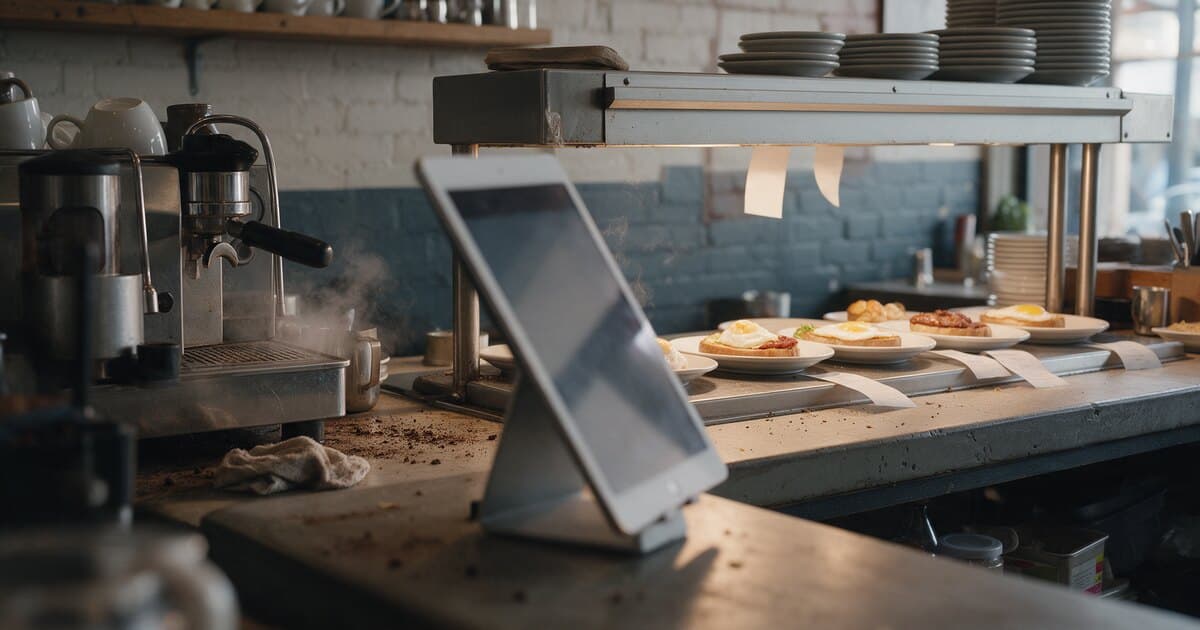
Waitstaff now enter orders at the table on an iPad. Dishes are timed, marked urgent where it matters, and grouped by table so the kitchen can plate a round together.
A live kitchen queue
The kitchen sees what's being made, what's ready, and which table each plate is heading to, live on a screen. Corrections stopped being shouted and tickets stopped getting lost.
End-of-shift reporting
End-of-shift and end-of-week reports show ticket-to-plate times by dish, slow combinations, and which dishes sell when. The owner makes menu and staffing calls on data rather than gut.
What changed.
Average ticket-to-plate time dropped by about 40%, and the mismatched-plates problem disappeared. Staff report fewer arguments between front-of-house and kitchen; diners get their food in sensible order.
The reporting has already driven menu decisions: two dishes that were consistent bottlenecks were reworked, and the café adjusted staffing on the two days that the data showed were consistently busier than the owner had assumed.
Frequently asked questions.
Why a custom build instead of an off-the-shelf EPOS?
Off-the-shelf EPOS systems handle ordering and payments well, but the kitchen-side queue with table routing and per-dish timing is where most of them are weak. The café's bottleneck was the kitchen knowing what to make next, in what order, for which table. Building the kitchen view to fit how this kitchen actually works produced the time saving; the front-of-house side is a thin layer on top.How disruptive is a kitchen cutover like this?
Cafés can't afford a closed-for-install week, so we do these as low-disruption phased cutovers: get the new kitchen view live alongside paper tickets, run both for a service or two so the kitchen has a fallback, then retire the paper once kitchen confidence in the queue display is earned. The technical install is the easy half. The real milestone is the kitchen trusting the screen enough to stop reaching for the paper; once that lands, the speed gains follow.
Need something like this built.
If this case study sounds like the kind of problem you have, here's where we'd start.
Websites
Business websites that turn local searches into enquiries. Quick on a phone, easy to update.
Read more about WebsitesCustom Software
Online stores, web apps, dashboards, and Excel migrations — built around how your business actually works.
Read more about Custom SoftwareAI & Automation
Process automation and AI workflows on rails — booking, invoicing, CRM, internal tools.
Read more about AI & AutomationAI Training
Practical workshops for business teams. Prompting, workflows, governance, real use cases.
Read more about AI TrainingLet's talk.
Tell us what you're trying to do. We'll reply within one working day.